
PHP2shell: Critical vulnerability
Contents
Step 1: Recognition: We have a problem.#
TL;DR: PHP currently has two critical vulnerabilities that allow for Remote Code Execution. Their identifiers are CVE-2026-109618 and CVE-2026-109619. Since the root cause lies within the engine itself, rather than the frontend, the only solution is to update to PHP 8.5.12, 8.4.27, 8.3.36, or 8.2.35.
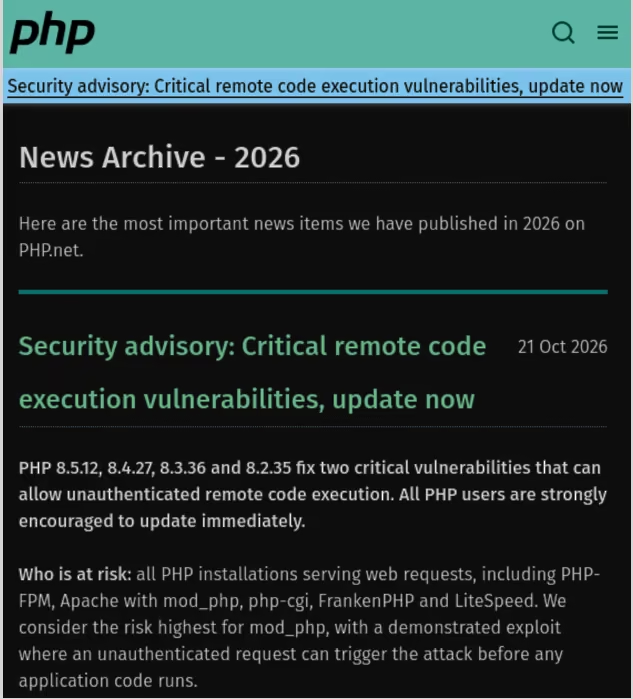
“I don’t use PHP on my website,” I think to myself upon receiving the following message this morning:
“Hi, quick heads-up: You might want to […] disconnect anything that uses PHP for now; […] a patch is coming later today.”
Or am I affected after all…? I do use a managed Nextcloud instance, and isn’t Nextcloud written in PHP, among other things…? As I write these lines, a fix for Nextcloud is becoming available. Everything has to happen very quickly. There will certainly be a lot of overtime worked today.
Status: October 21, 2026, 10:30 AM CEST#
Let’s rewind ten hours. There is no fix yet. Information about the CVEs has leaked and is already a few hours old. According to Wikipedia, 69% of all websites use PHP. Exploiting such a highly critical vulnerability (with a score of 9.2) in such a widely used technology naturally has a huge blast radius. Consequently, “the internet” is quite nervous.
“[…] organisations should consider isolating internet-facing applications from public networks until a fix is applied and verified.” — CERT-EU, accessed October 21, 2026, 10:40 AM
Interesting. The recommendation is to “take it offline for now.”
Step 2: Immediate Measures: Taking Nextcloud Offline#
To get ahead of a potential attack, I attempt to take my instance offline. I log in to my hoster’s platform, navigate to the “Settings” tab, and click on the ownCloud Console section. This is Nextcloud’s command-line interface.
Once there, I discover that there is no command available to shut down or “de-publish” the instance. So, I opt for the next best thing:
occ maintenance:mode --on
So, I put my instance into maintenance mode. This prevents new logins and freezes the database. Afterward, I read up a bit on the CVEs to see if this step is sufficient.
Apparently, it is not.
Through various forums and HackerNews, I learn that an unauthenticated request can trigger the attack before any PHP code is even executed on the server side.
In other words, it doesn’t matter what state I set my instance to, as long as it is connected to the network, it remains vulnerable.
Step 3: Interim Containment: Having the Nextcloud Instance taken offline#
Even after several online searches, I cannot find a way to shut down my managed instance myself. I briefly consider killing the name resolution and DNS routing, but I quickly realize that by the time those changes propagate, the fix will likely already be available.
Status: October 21, 2026, 11:43 AM CEST#
So, I submit a support ticket to my hoster, requesting assistance in taking my instance offline.

Status: October 21, 2026, 12:01 PM CEST#
I receive an email from my hoster!
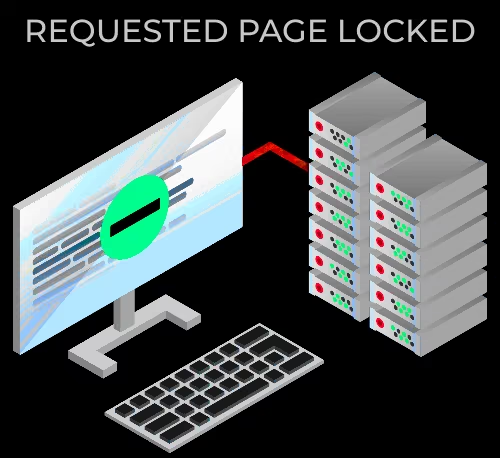
Sure enough, I can no longer access the instance. I’m met with an ERR_CERT_COMMON_NAME_INVALID error. Dismissing that, a message appears: REQUESTED PAGE LOCKED. Well done. The provider’s response time, including notifying the customer, was just 18 minutes.
Now, I shift from participant to observer. I’m seeing initial exploit attempts (or at least claims of them) circulating online, which brings to mind a slide from a presentation I recently watched: Security in the LLM age (at the 11:24 mark).
In it, a Linux kernel expert points out that, as of 2026, exploits are appearing in the wild an average of seven days before a patch for the affected software is even released.
discover --> disclose --> patch --> deploy
This traditional sequence of events only works well against “slow” attackers. We need something that allows us to get back ahead of the situation.
Step 4: Monitoring the Situation - Patch Availability and Initial Deployment#
According to The Hacker News, the patch is set to become available around 4:00 PM CEST. I am obtaining the RSS feed from my hosting provider and awaiting further updates.
Status: October 21, 2026, 14:20 CEST#
The Federal Office for Information Security (BSI) has also issued an IT security advisory, which classifies the vulnerability as having a “criticality level of 3/Orange” and notes the following:
“Der Patch für die Schwachstelle ist heute 16 Uhr deutscher Zeit (14:00 UTC) angekündigt und sollte unverzüglich zu diesem Zeitpunkt installiert werden.” - BSI, 21.10.2026

Status 21.10.2026 16:34 CEST#
My hoster reports that patches are now available and that implementation has begun. Affected systems include not only the Nextcloud instances but also the hoster’s entire administration interface and their webmail service.
Status 21.10.2026 19:52 CEST#
My hoster reports that the patches have been successfully applied to their web hosting services and managed servers.
Status 21.10.2026 22:40 CEST#
Hetzner’s KonsoleH application, which I use to manage my Nextcloud instance, is down.
Status 21.10.2026 23:00 CEST#
KonsoleH is back online (and patched).
Step 5 Insights and Conclusions#
What have I learned from the events of this turbulent day? How should I handle security vulnerabilities in the future? And how can I even tell when a problem exists?
- It is not just the service as a whole that is vulnerable, but its individual components as well. –> Know all your components and keep an eye out for vulnerabilities and patches!
- Adversaries have become incredibly fast (thanks to LLMs). –> Expect exploits to appear even before patches are available!
I am currently compiling a list of reliable sources for information on vulnerabilities, news, and patches. Once the list is finalized, I will share it.
Step 6 Actions#
- Remove sensitive data from the network whenever possible. Line of thought: What if this were to disappear? Would availability within the LAN/intranet suffice?
- Improved monitoring and abuse detection are the logical next steps: detect early, block early, report early, shut down early, and patch immediately.
- Identify standard sources for information regarding the software in use. Perhaps build a CVE list scanner? Or a Hacker News filter?
Addendum: Oct 22, 2026, 09:30 CEST#
The hoster has patched my Nextcloud instance and brought it back online. All of my systems are back to normal. There is now also a Wikipedia entry on the subject, which is kept very up to date.
Step 7: Initial Reflection#
A few days have passed since the two security vulnerabilities were publicly disclosed and patches were made available. Let’s take a look at the current landscape across the web.
Status: October 24, 2026, 16:30 CEST#
There are now many, many proofs of concept (PoCs) demonstrating how to exploit these PHP vulnerabilities. Most notably on the platform GitHub.
Personally, I am not an expert in this field, so I have to rely on the assessments of others regarding the quality of these PoCs, the actual feasibility of exploiting them “in the wild,” and the reasons why this particular vulnerability accumulated such significant media attention.
In general, the rule is, of course: “Patch first, ask questions later.” That is exactly what I did. To quote Felix von Leitner once again:
“One of the lessons learned from 20 years of working in the security field is that when one person claims a bug exists, and another claims it isn’t exploitable, it almost always turns out, in hindsight, that it was exploitable after all.” - Feliks von Leitner, alias Fefe, April 12, 2014, accessed October 24, 2026
Regarding exploitability, flare.io which describes itself as a threat intelligence site, notes that most proof-of-concept (PoC) exploits for PHP2shell only functioned within laboratory environments. They are rarely applicable to real-world targets. Either because they require internal operational knowledge of the systems being attacked, because they depend on other vulnerabilities (such as the disabling of memory randomization), or because the PoCs themselves are merely “AI-slop”: poorly validated, hastily written software that promises more than it delivers.
eliastaylor expresses a similar view:
“There isn’t an easy exploit for this PHP vulnerability.” - https://eliastaylor.com/noexploit/, accessed October 24, 2026
Writing less than ten hours after the attack vector and patch were released, he argues that:
- none of the proof-of-concept (PoC) exploits actually work. Not even on a standard installation and configuration of a pre-patch version of PHP
- these two CVEs are far less critical than other historical security vulnerabilities (citing Heartbleed in OpenSSL as an example)
- the exploits were not crafted by actual humans, but rather generated with the help of LLMs.
The core of the argument is that people are delegating their cognitive work to language models, failing to verify whether the system is actually doing what it claims to do. Let alone reading, understanding, or improving the code the system generates. Malicious botnets are still crafted by human hands, a process that takes time, especially when the vulnerabilities are not obvious or trivial to exploit.
As a brief exercise to help form an own assessment of the situation, I recommend scanning the “issue” discussions found on the GitHub repositories for many of these “PHP2Shell” PoCs.
However, the significant media attention has some advantages: it seems the world is patching quickly. I’ve taken a look at the discourse across various German and international forums: everywhere, people are pushing their hosting providers to apply patches, discussing the potential impact, and tracking which vendors have already released updates.
That still leaves the question of who actually benefits from all this. I have a few theories. However, it is still too early to draw conclusions or form a judgment.
Status: October 27, 2026, 17:00 CEST#
The vulnerability has been officially confirmed as being exploited.
Step 8: Analyzing observations and adjusting information channels#
I am now focusing on reports regarding the exploitation of these vulnerabilities. The sheer volume of Proofs of Concept has become unmanageable for any single individual. Some private individuals and companies like Cloudflare have begun organizing “Capture The Flag” (CTF) competitions: they place intentionally vulnerable PHP instances online and challenge participants to compromise them and provide proof.
This is a clever way to separate the sheep from the goats. It forces individuals to test their PoCs against sparring partners who do not disclose their underlying stack. As an added layer of difficulty, some organizers require that standard defense mechanisms, such as Web Application Firewalls (WAFs), be bypassed as well. If a PoC succeeds under these conditions, it can be considered a valid exploit demonstrated in a realistic environment.
Understanding the PoC#
Thanks to eliastaylor, I have located the PoC that successfully solved the “StealMyBitcoin” PHP2Shell CTF. Both the comments within the Python file regarding the exploit mechanism and the discussion on GitHub—covering the specific LLM variant, prompt, and configuration used, are quite interesting.
As I interpret the sources and commentary surrounding this PoC, it offers an elegant solution to the shortcomings of previous attempts:
- Effectively forcing PHP into a memory-constrained state during a multipart upload: Instead of sending thousands of requests in rapid succession, hoping to hit the “right” worker thread, this attack employs “deeply nested field names”1. This keeps the payload small while causing server-side memory consumption to explode, all within a single request.
This targets the vulnerability CVE-2026-109618, where an “out-of-memory” condition can interrupt PHP while internal request data is only partially initialized; the subsequent request cleanup process may then mistakenly treat this invalid data as valid. The purpose of the heap_consumer is to manipulate the residual data left behind following the memory overflow.
- Bypassing ASLR (Address Space Layout Randomization): Rather than ignoring ASLR in a real-world scenario (or simply disabling it in a lab environment), the memory overflow, data manipulation, and the subsequent request to trigger the processing of that manipulated data must all occur within the same session and on the same, exhausted worker process2. Otherwise, the affected memory region becomes nearly impossible to locate and will eventually be reset by the system once it detects that the worker has stalled. Consequently, the exploit must ensure that the malicious code is already in place by the time PHP invokes the corresponding destructor, which ultimately triggers the RCE (Remote Code Execution).
This relates to the second CVE in the set: CVE-2026-109619 states “request-owned internal state can survive after its backing memory has been freed. A later request handled by the same worker may use that stale state before normal initialization resets it.”
It would be great to hear from a PHP engine expert on this! :)
This effectively places an tool in the hands of malicious actors, making (automated) exploitation feasible against “easy targets” that lack proper hardening.
Hardening#
The only way to resolve this issue is by applying the patch. The following hardening measures can at least increase resistance against this specific attack vector:
- Either avoid offering the
PHP_SESSION_UPLOAD_PROGRESScommand which is used to carry out the attack. Or restrict requests so that they cannot occur in rapid succession, within the same session, or from the same machine. - Increase the number of workers to the maximum, even if this impacts the machine’s performance. This makes it more difficult for an attacker to re-capture and exploit a worker that has already been compromised.
Later that same day#
The Hacker News confirms the exploitation and lists affected companies, major corporations, and suppliers. The bottom line: patch, patch, patch!
Status as of October 28, 2026, 21:30 CEST#
Cloudflare has since released new firewall rules for its WAF designed to intercept attackers before they reach the target servers. The Hacker News reports on specific incidents involving initial damage. Threat intelligence firms have confirmed these findings.
To round out this update, here is a useful collection page containing information about “x-2-shell” vulnerabilities.